
Golf Mental Training: 7 Exercises for Your Mental Game, From First Tee to Final Putt
You make a double bogey on the 4th. By the time you reach the 5th tee you have replayed the chip three times and worked out what you now need on the back nine. Then you tee it up with all of that still in your hands. Golf gives your mind more time than almost any other sport: a round takes around four hours, and only a few minutes of it are spent hitting the ball. Golf mental training works on the rest, and these seven exercises cover the whole round.

Why golf plays by its own mental rules
- Long gaps between shots. Your mind fills them on its own, usually with the last shot or the scorecard. Focus in golf is not held for four hours but switched on for each shot and off again afterwards.
- The ball is not moving. No opponent sets the tempo. Every shot starts with you, and so does every doubt.
- One hole bleeds into the next. The real cost of a double bogey on the 4th is often the tee shot on the 5th, hit with the frustration still in your grip.
- The maths never stops. Working out after every hole what the round will do to your handicap index means playing against a number instead of the course.
- Someone is always watching. Your playing partners see every shot, and on the short putts everyone expects you to hole, that audience gets loud in your head.
Mental training improves sport performance measurably, and imagery is among the best-evidenced methods.
Brown & Fletcher, Sports Medicine, 2017 · Simonsmeier et al., Int. Rev. Sport Exerc. Psychol., 2021Golf has its own line of research here, since much of the classic work on choking was done on the putting green. A central finding: experienced golfers putt worse under pressure mainly when their attention turns to the stroke itself, a movement that has long been automatic. Most exercises below therefore move attention off the body and onto the target and the routine.
Beilock & Carr, J. Exp. Psychol. Gen., 2001What 731 golfers tell us in Sync
The 731 golfers in Sync have a median age of 55, against 28 across all users. More than three quarters, 77.2 percent, are 45 or older (all users: 31.0 percent), and 62.7 percent play competitively. In our data, golf is the grown-ups' sport.
That shapes what they want to work on. Only 25.6 percent of golfers name motivation as a mental topic, against 49.7 percent of all users. If you are booked on the first tee at 7:30 on a Saturday, getting started is rarely the problem. Three other values sit above average instead:
- Bouncing back after mistakes is a goal for 57.7 percent (all users: 48.3 percent).
- Decisive moments are a goal for 36.5 percent (all users: 28.4 percent). In golf, that means the first tee and the putt the round hangs on.
- Relaxation is a topic for 43.5 percent (all users: 38.3 percent).
363 golfers answered the question on mental topics (all users: 5,023), and 665 the one on goals (all users: 10,958). Multiple answers were possible, and these are users of a mental training app, so this is not a representative sample. The direction is still clear: in golf the issue is less getting going than what happens after the bad shot, and staying calm when one stroke matters.
7 mental training exercises for golfers
1. A pre-shot routine with a decision line
Many coaches work with two zones made popular by Pia Nilsson and Lynn Marriott. Behind the ball is the think box, where every decision gets made: lie, wind, target, club. Then you step across an imaginary line, a single step to the side. From there you are in the play box, where nothing gets analysed. Just the target picture and the feel of the shot, then the swing.
The rule: if doubt creeps in once you are in the play box, step back and start again. No shot gets hit with half a commitment. Research on routines in golf suggests the details can be your own. What matters is that it runs the same way every time.
Cotterill, Sanders & Collins, J. Appl. Sport Psychol., 20102. Pick a target, not a hazard
"Whatever you do, don't go in the water" puts the water firmly in the picture. In a well-known experiment, people told not to hit a putt past the hole did exactly that more often once their minds were also busy with something else.
Wegner, Ansfield & Pilloff, Psychological Science, 1998Similarly, golfers hit pitch shots more accurately when their attention is on the motion of the club rather than on their arms, beginners and experienced players alike.
Wulf & Su, Res. Q. Exerc. Sport, 2007So before every shot with trouble in play, say one sentence that contains only the target: "left half of the green", not "anything but right". Pick a small target, a tree trunk or the lip of a bunker, never just "the fairway". If your sentence contains a "don't", rephrase it before you step into the play box.
3. Play the first tee before you get there
First-tee nerves are normal and say nothing about how the round will go. What helps is making the situation familiar before you stand in it. The evening before a competition, spend five minutes running it through in your head, through your own eyes: the feeling in your stomach, the people by the clubhouse, your routine, the ball in the air. Picture yourself being nervous and still completing the routine.
On the tee itself: two or three breaths behind the ball, four seconds in, six to eight out. Take a club you trust today, even if it is not the driver. The only goal for that shot is a complete routine. More in our guide to nerves before competition.
4. A reset ritual as you walk off the green
Until you reach the edge of the green, the frustration is allowed. As you walk off, run a short ritual, the same every time:
- One factual sentence. "Approach short, misjudged the wind." No verdict, no "typical".
- A full stop. Putter back in the bag, undo the glove and fasten it again, one long exhale.
- Switch off on the walk. Look at the course, talk to your playing partners about anything except your score.
- Restart on the tee. The next hole begins in the think box, not before.
Run the ritual after good holes too, or it turns into a mistake signal. Why the loop after a mistake costs more than the mistake itself: bouncing back from mistakes.
5. Breathing and a quiet eye on short putts
The three-footer you hole half asleep on the practice green becomes a question on the 18th. Your grip tightens, the stroke gets jerky. Before you settle over the ball: one deep breath in, a clearly longer one out. Then pick a spot on the back of the ball and keep your eyes on it through the stroke and for a moment after contact. In highly skilled golfers, training this gaze control, known as the quiet eye, improved putting under pressure and in competition.
Vine, Moore & Wilson, Frontiers in Psychology, 2011If a twitch in your putting stroke persists for weeks, it may not be purely in your head. Research describes the yips as a spectrum between choking and a movement disorder called focal dystonia. Get it checked by a doctor and talk to your pro.
Smith et al., Sports Medicine, 20036. Process goals instead of the scorecard
Seven good holes in, the maths starts: two more bogeys and my handicap index comes down. From that moment you are playing against a number, and the swings get careful.
Instead, set two or three goals per round that depend only on your behaviour: "full routine on every shot", "reset after every hole" and "eyes on the back of the ball on every putt". Tick them off after each hole on a separate card. Add up your score only after the 9th and the 18th, never in between.
7. Manufacture pressure in practice
On the range you hit fifty balls with a 7-iron, no consequence attached. On the course you get every shot exactly once. Three ways to narrow that gap:
- Play the course on the range. Every ball with a different club, at a different target, with your full routine.
- Putting games with a consequence. Six balls in a circle, three feet from the hole. You are done only when all six drop in a row.
- Bring an audience. Ask someone to watch you putt, or film yourself. In Beilock and Carr's studies, golfers who had practised putting in front of a camera held up better under later pressure.
The goal is not to make pressure pleasant but familiar. More in our guide to performing under pressure.
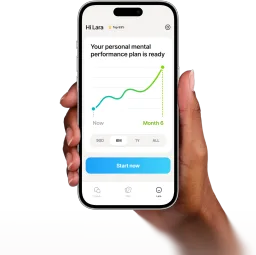
Mental training for golf with Sync
Golf is its own sport in Sync. You get daily audio sessions of 10 to 15 minutes, built around golf and what you want to work on, a match plan for the days that count, and immediate help for acute nerves. Start for free.
Read on
To see what golf mental training looks like in the app, visit the golf section. And if you want to know how you tick on the course and what pressure does to you, the mental profile asks 49 short questions from your sport and takes about 8 minutes, free and with no account.
Frequently asked questions
What is golf mental training?
It trains what decides the next shot in the time between shots: a routine that holds under pressure, a target picture instead of the hazard, closing off a bad hole, and calm on short putts. It does not replace swing work, but it helps more of your range game reach the course.
How do I stay focused for 18 holes?
Not continuously, and you don't need to. Focus in golf means switching on for each shot and deliberately off afterwards. The pre-shot routine turns it on, the ritual as you walk off the green turns it off. In between, your mind can rest.
How do I handle first-tee nerves?
Two or three long exhales behind the ball, a club you trust today, and a complete routine as the only goal. The evening before, run the tee shot through in your head, nerves and spectators included.
Do I need a mental coach for golf?
Not to get started. Routine, reset, breathing and process goals can be trained on your own, and a structured programme helps more than scattered tips. A sport psychologist or mental coach is worth it if you want individual work, or if the tension weighs on you beyond the course.
References
- Brown, D. J., & Fletcher, D. (2017). Effects of Psychological and Psychosocial Interventions on Sport Performance. Sports Medicine.
- Simonsmeier, B. A., et al. (2021). The effects of imagery interventions in sports. International Review of Sport and Exercise Psychology.
- Beilock, S. L., & Carr, T. H. (2001). On the fragility of skilled performance: What governs choking under pressure? Journal of Experimental Psychology: General.
- Cotterill, S. T., Sanders, R., & Collins, D. (2010). Developing effective pre-performance routines in golf: Why don't we ask the golfer? Journal of Applied Sport Psychology.
- Wegner, D. M., Ansfield, M., & Pilloff, D. (1998). The putt and the pendulum: Ironic effects of the mental control of action. Psychological Science.
- Wulf, G., & Su, J. (2007). An external focus of attention enhances golf shot accuracy in beginners and experts. Research Quarterly for Exercise and Sport.
- Vine, S. J., Moore, L. J., & Wilson, M. R. (2011). Quiet eye training facilitates competitive putting performance in elite golfers. Frontiers in Psychology.
- Smith, A. M., et al. (2003). The 'yips' in golf: A continuum between a focal dystonia and choking. Sports Medicine.
This article provides general information about mental training in sport and does not replace psychological or medical advice. If competition anxiety persists or causes significant distress, please consult a qualified sport psychologist or physician. If a twitch or tremor in your putting stroke persists, please have it checked by a doctor.