
Mental Training for Table Tennis: 7 Exercises for the Fastest Sport There Is
Table tennis has the shortest reaction times and the shortest breaks in sport. A rally often lasts under five seconds, with about ten seconds between them. There is no time for deliberate thinking, which is exactly why the mental side works differently here than in tennis. The job is not to gather yourself between points, it is to avoid reaching the state you would need to gather yourself from. Seven exercises for that.
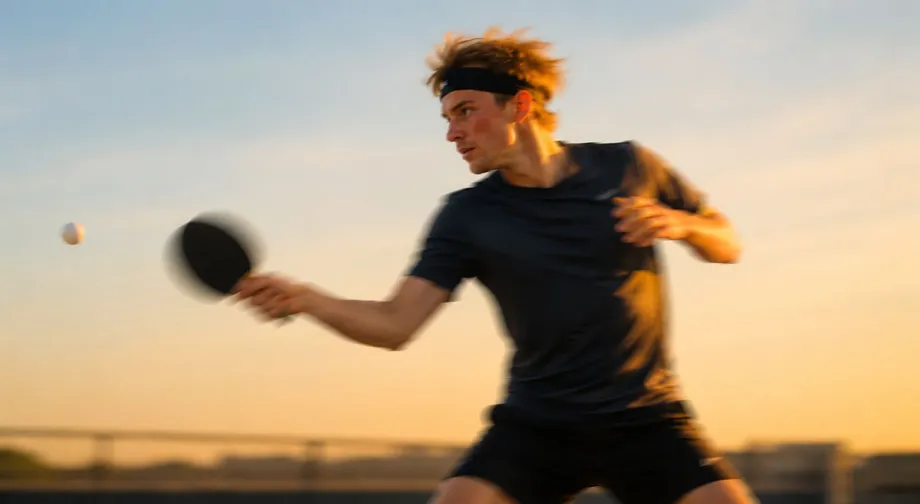
Why table tennis plays by its own mental rules
- No time to think, plenty to doubt. Ten seconds is not enough to analyse an error, but it is enough to get annoyed. In-match analysis in table tennis is almost always a mistake.
- A game turns on three points. At 11 points, being 8-5 up is not safe. That brevity produces pressure precisely when you think the game is done.
- The serve is a weapon in itself. Unlike most sports it does not just start the rally, it often decides the point. And it is your only moment of full control.
- It all happens across three metres. Your opponent sees every reaction, every posture, every hesitation. Body language is part of the game here.
Mental training measurably improves sport performance, and imagery is among the best-evidenced methods.
Brown & Fletcher, Sports Medicine, 2017 · Simonsmeier et al., Int. Rev. Sport Exerc. Psychol., 2021Our own numbers point the same way. Of 518 table tennis players who named their mental topics when starting with Sync, 68 percent named nerves. Only tennis is marginally higher at 69 percent, while running sits at 39 percent. Multiple answers were possible, and these are users of a mental training app rather than a representative sample.
7 mental training exercises for table tennis
1. The three-second reset
There is no room here for the longer point reset used in tennis. You need a short form that fits the gap between two rallies:
- A physical signal. Towel hand on your leg, bounce the ball twice, one turn of the bat. Always the same one.
- One word forward. "Next", "short", "legs". Not a sentence, a word.
- Eyes on the ball, not on your opponent.
Three seconds is enough. What matters is that it happens after every rally, not only the lost ones. Otherwise the movement itself becomes an error signal, and across three metres your opponent reads it.
2. The serve routine as your anchor
The serve is your only moment of complete control, which makes it the best place for a fixed routine. Decide: how many times you bounce the ball, where you look, when you exhale, how long you stand before the toss.
The effect is twofold. It steadies you, and it costs time, which is exactly what you need at 9-9. If you serve faster at a tight score than at 5-2, the routine has slipped, and that is usually the moment the game turns.
3. Extended exhales in the breaks
Between games and at the change of ends you have time, and almost never otherwise. Use it: in for four seconds, out slowly for six to eight, two or three cycles. That lowers heart rate within seconds. During a game, a single long exhale before serving is enough.
4. A plan for being ahead
The most common collapse in table tennis is not the deficit, it is the lead. At 9-6 many players start trying to win the game rather than continuing to play it. That changes shot selection: more passive, safer, shorter.
The antidote is a rule you fix beforehand and do not renegotiate. For example: "from 8 points I serve exactly what I served at 0." Or: "when ahead, the next ball is attacking, whatever just happened." The rule replaces a decision you have no time to make.
5. Two tactical anchors instead of analysis
Analysing mid-match costs precisely the attention the next ball needs. Reduce your plan to two points you can call up between rallies, such as "long to the forehand" and "first ball attacking".
Everything else belongs in the break between games or in the post-match review. Two anchors hold under pressure. Five do not.
6. Imagery for the three critical scores
Do not rehearse the whole match. Take three concrete scores and run them through before sleep:
- 9-9 in the deciding game, your serve
- 5-9 down, needing a run
- 10-8, game point to you
Detail counts: the sound of the ball, the grip, your opponent's posture. And above all, picture yourself staying calm in those moments, not just the ball landing. Imagery practice demonstrably improves movement execution and competitive performance.
7. Manufacture pressure in practice
What you can do in relaxed practice does not automatically survive a deciding game. Build in artificial pressure:
- Start practice games at 7-7.
- Play games where only points starting with your intended serve count.
- Have someone watch and keep score from 9-9.
The goal is not to make pressure pleasant but familiar. A score you have practised fifty times is information. The same score for the first time is panic.

Mental training for table tennis with Sync
Sync gives you a plan for exactly these skills: resetting between rallies, serve routines, focus in the deciding game. Daily sessions of 10 to 15 minutes. App-based mental training can improve athletic performance by reducing anxiety and stress while strengthening resilience.
Gao et al., Journal of Medical Internet Research, 2024 · O'Daffer et al., JMIR mHealth and uHealth, 2022
Get Sync for freeA four-week entry
- Week 1: The three-second reset only (exercise 1), after every rally in practice.
- Week 2: Add the fixed serve routine (exercise 2).
- Week 3: Two tactical anchors before each match (exercise 5) and the rule for being ahead (exercise 4).
- Week 4: Imagery three times a week (exercise 6), pressure built into practice (exercise 7).
The breathing (exercise 3) runs from week 1 in the breaks between games. First changes usually appear after two to four weeks; holding up in a deciding game develops over six to twelve.
Read on
The general guide to nerves before a competition goes deeper on arousal regulation. For how this works in tennis, where the gaps are longer, see the tennis guide. The app's table tennis section is here. And if you are still choosing an app: 7 criteria that matter.
Frequently asked questions
What does mental training do for table tennis?
It trains the skills that decide games when there are only ten seconds between rallies: resetting within seconds, keeping the serve stable under pressure, not turning passive when ahead, and holding two simple tactical anchors in a deciding game instead of analysing.
How do I stay calm in the deciding game?
Two things work immediately: one long exhale before every serve, and a serve routine that runs exactly the same at 9-9 as it does at 2-0. If you speed up at a tight score, the routine is gone, and that is usually when the game turns.
Why do I lose games from a winning position?
Because at around 8 or 9 points the goal shifts: instead of continuing to play, you start trying to win the game. That makes shot selection passive and short. The fix is a rule fixed in advance and not renegotiated during play, such as serving exactly what you served at the start, so no decision is needed in the moment.
How long does mental training take to work in table tennis?
First improvements in composure and error recovery usually appear after two to four weeks of daily practice of 10 to 15 minutes. Holding up in a deciding game develops over six to twelve weeks.
References
- Brown, D. J., & Fletcher, D. (2017). Effects of Psychological and Psychosocial Interventions on Sport Performance. Sports Medicine.
- Simonsmeier, B. A., et al. (2021). The effects of imagery interventions in sports. International Review of Sport and Exercise Psychology.
- Toth, A. J., et al. (2020). Does mental practice still enhance performance? Psychology of Sport and Exercise.
- Gao, Y., et al. (2024). App-based mental training in sport. Journal of Medical Internet Research.
- O'Daffer, A., et al. (2022). Efficacy of mental health apps. JMIR mHealth and uHealth.
This article provides general information about mental training in sport and does not replace psychological or medical advice. If competition anxiety persists or causes significant distress, please consult a qualified sport psychologist or physician.