
Choosing a Mental Training App: 7 Criteria That Actually Matter
Search for a mental training app and you mostly find one thing: a lot of apps doing much the same job. Guided relaxation, breathing exercises, a calming voice, a sporty cover image on top. That is meditation with a sports label, and it is not the same as mental training. Meditation helps you get calmer. Mental training helps you function under pressure. The difference decides whether an app is any use to you in a tiebreak or on the starting blocks. This guide gives you seven criteria you can check before you download. For the concrete apps on the market, see our separate comparison of mental training apps.

Disclosure first: we are a vendor
Sync is our app. This is therefore not an independent review, and we are not going to pretend otherwise. That is why you will not find a ranking here with us at number one, and no comparison table making claims about competitors we cannot verify.
What you will find instead: the criteria we would use ourselves, stated plainly enough that you can apply them against us too. At the end we score Sync against all seven, including where it falls short.
Meditation or mental training? The distinction that matters
Both are useful, for different jobs.
Meditation and relaxation lower your general arousal. You get calmer, sleep better, wind down. That is genuinely valuable, but it happens away from competition, somewhere quiet, with time available.
Mental training builds skills you have to produce during competition: resetting within ten seconds of an error, putting your eyes on an anchor point before the serve, running a routine while your heart rate sits at 170. That requires specific exercises and repetition under load, not just calm.
The rule of thumb: if an app only teaches you to be relaxed, it helps with competition anxiety right up to the moment competition starts.
7 criteria for choosing
1. Is the content sport-specific?
A double fault at break point, a penalty kick and the swimming start are three different mental problems. An app running the same programme for everyone cannot address them. Check the description or the screenshots for concrete situations from your sport. If it only talks generally about "focus" and "calm", it is a relaxation programme.
2. Are there exercises for pressure, not only for calm?
Look for content like pre-performance routines, error resets, handling expectation, attentional anchors. Those are the tools that work in competition. If none of that appears, see criterion 1.
3. Is it a plan or a library?
Mental skills come from repetition, not from insight. A library of 200 individual exercises sounds generous, but in practice you browse for two weeks and then stop. What works is a sequence that tells you what today's session is. Ask yourself: does the app know where I am, or do I have to organise that myself?
4. Is the evidence base traceable?
Not "developed by experts", but: which experts, with what qualification? Are methods named that you can look up, such as imagery, self-talk regulation, arousal regulation? Are there references? Sport psychology is a well-researched field, and psychological interventions measurably improve sport performance. An app leaning on that should be able to say exactly what it is leaning on.
Brown & Fletcher, Sports Medicine, 2017 · Simonsmeier et al., Int. Rev. Sport Exerc. Psychol., 20215. Do the sessions fit your actual week?
Ten to fifteen minutes daily is realistic and sufficient. Forty-minute sessions sound more thorough but stop happening after ten days, at which point the effect is zero. Consistency beats duration, and it is the single biggest factor.
6. Can you see progress?
Mental improvement feels slow, because it is. Without feedback you quit before it works. Some form of history, streak or self-rating over time is what keeps you going. That is not a gimmick, it is the reason people persist.
7. Are price and cancellation transparent?
Visible before you download: what is free, what costs money, how long the subscription runs, how you cancel. If you only find out after signing up, that itself tells you something about the vendor. A free entry point is good, but only if what follows is clear.
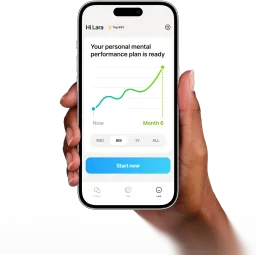
Mental training for your sport, free to start
Sync gives you a personalised plan for your sport: daily sessions of 10 to 15 minutes, exercises for pressure situations, grounded in sport psychology. App-based mental training can improve athletic performance by reducing anxiety and stress while strengthening resilience.
Gao et al., Journal of Medical Internet Research, 2024 · O'Daffer et al., JMIR mHealth and uHealth, 2022
Get Sync for freeHow Sync scores against these seven
Measured against our own criteria, limitations included:
- Sport-specific: yes, with dedicated sections for soccer, tennis, golf, running, swimming, equestrian and table tennis.
- Pressure situations: yes, that is the core rather than an add-on module.
- Plan not library: yes, a personalised training plan.
- Evidence base: sport-psychology background on the team, methods named. What we do not have: our own clinical efficacy trial of the app itself. The references cited concern mental training and app-based training in general, not Sync specifically. That is true of essentially every app in this space, but it should be said.
- Sessions: 10 to 15 minutes.
- Progress: yes.
- Price: free entry point on iOS and Android.
Where Sync is not the right choice: if you want a pure meditation app, more specialised ones exist. If you need weekly one-to-one conversations, individual sport psychology is the right format, not an app. And for symptoms that need treatment, an app is not the tool at all, on which more below.
What an app cannot do
This boundary matters more than any selection criterion.
Mental training works in the performance domain: regulating arousal, holding focus, building confidence, recovering from mistakes. For depression, an anxiety disorder or persistent distress it is not the tool, however good the app. The difference between performance anxiety and an anxiety disorder, and where the line sits, is covered in our overview of mental health in sports.
What does the alternative cost?
Some context helps. One-to-one sport psychology typically runs from the mid two figures into three figures per session, and availability outside performance centres is often thin. That gap is what apps aim at: not as a replacement for individual work, but as daily practice that would otherwise not happen at all. If you can combine both, that is the strongest option.
Frequently asked questions
What is the difference between a mental training app and a meditation app?
Meditation apps lower general arousal, so you get calmer and sleep better. Mental training apps build skills you have to produce during competition: error resets, pre-performance routines, attentional anchors, handling expectation. Many apps calling themselves sports psychology in practice offer the former. The test is whether concrete competition situations from your sport appear.
What should I look for in a mental training app?
Seven things: sport-specific content, exercises for pressure rather than only relaxation, a plan instead of an exercise library, a traceable evidence base with named methods, sessions of 10 to 15 minutes, visible progress, and price and cancellation terms you can see before downloading.
Does mental training via an app actually work?
Research on app-based mental training shows improvements in athletic performance through reduced anxiety and stress, alongside strengthened resilience. The important qualification: those findings concern app-based mental training in general, not proof of efficacy for any particular app. What decides the effect is consistency rather than which vendor you pick.
Does an app replace a sport psychologist?
No. An app provides daily structured practice that one-to-one work usually cannot, for reasons of time and cost. Individual assessment, working on deeper issues and treating mental illness belong with professionals. Combining both is the strongest option.
How long does an app take to work?
First changes in composure and error recovery usually appear after two to four weeks of daily practice of 10 to 15 minutes. Holding up under real competition pressure develops over six to twelve weeks.
References
- Brown, D. J., & Fletcher, D. (2017). Effects of Psychological and Psychosocial Interventions on Sport Performance. Sports Medicine.
- Simonsmeier, B. A., et al. (2021). The effects of imagery interventions in sports. International Review of Sport and Exercise Psychology.
- Gao, Y., et al. (2024). App-based mental training in sport. Journal of Medical Internet Research.
- O'Daffer, A., et al. (2022). Efficacy of mental health apps. JMIR mHealth and uHealth.
- Lee, S., et al. (2024). Digital interventions for psychological wellbeing. Scientific Reports.
This article is published by Sync, a vendor of app-based mental training, and is not an independent product review. It provides general information and does not replace psychological or medical advice. If anxiety persists or causes significant distress, please consult a qualified sport psychologist or physician.