
Control the start-block nerves, stay focused in the water, and build the mental precision to swim your best time when it matters most — from the dive to the touch.
Swimming is one of the most psychologically demanding individual sports. The race happens in near-sensory isolation — no crowd noise, no visual reference to opponents once you're underwater — and is decided in seconds or fractions thereof. Pre-race anxiety, the ability to execute a perfect start under pressure, and the capacity to hold technique when lactic acid peaks in the final metres are all mental challenges. Elite swimmers invest heavily in sport psychology because at the highest level, physical preparation is near-equal and mental skills are the decisive variable.
Controlling pre-race arousal on the starting block is one of the highest-leverage mental skills in swimming. The seconds before the start signal determine whether you dive with explosive precision or a tense, reactive jump. Sync's pre-race sessions teach arousal regulation techniques that put you in the optimal performance state — activated but calm — on the block.
Once in the water, external focus cues disappear. Maintaining stroke count, pace, and technique without visual feedback requires a disciplined internal attention system. Sync trains the attentional focus skills that keep your stroke clean and your pace honest across every length — especially the hard ones.
The last 15–25 metres of any swim race are a mental battle. Lactic acid peaks, technique breaks down, and the instinct is to tense up rather than accelerate. Mental training teaches you to stay long and loose when the body demands you shorten up, and to push harder when every signal says ease off.
Regulate pre-race arousal for explosive, clean starts every time you step on the block.
Maintain technical precision through internal attentional cues even when fatigue sets in during the race.
Build the mental pacing control to hold a target split even when adrenaline pulls you faster in the opening metres.
Train the psychological drive to accelerate in the final metres when pain peaks and every instinct says ease off.
Develop a mental preparation sequence for warm-up and blocks that creates optimal race-day arousal consistently.
Recover quickly from a bad heat or split and perform at full capacity in the next race of the day.
Download Sync and tell us you swim. You can specify your level — youth club, regional, national, or elite — so the app tailors its recommendations precisely to your situation and competitive goals.
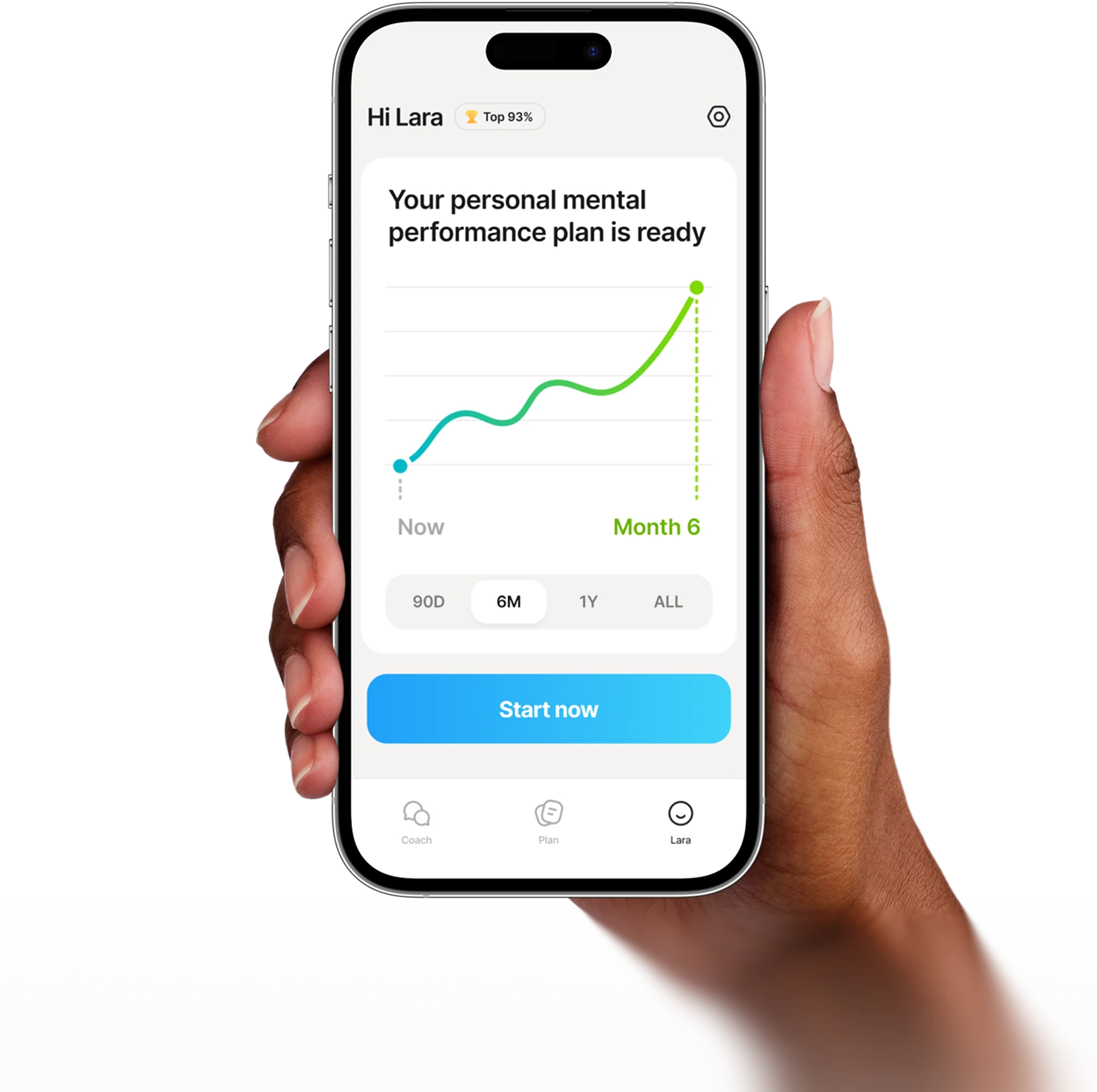
Sync builds you a structured plan based on your stroke, your events, your current mental strengths and the areas you most want to improve — whether that is pre-race composure, focus, split discipline, or resilience between heats.
Each session takes 10–15 minutes and is designed to fit around your training schedule. Complete them at home, poolside, or in the warm-up hall before a competition — and track your progress over time.
An extensive library of guided visualisations, focus exercises, and breathing techniques — all accessible on demand.
Whether you swim, run, cycle, or play team sports — Sync adapts its plan individually to your sport and event.
Expert-led lessons covering the core principles of sport psychology, self-regulation, and performance optimisation.
A growing community of athletes at every level who use Sync to strengthen their mental game and perform at their best.
One plan covers your entire squad. Every swimmer on your team gets a personalised mental training programme, tailored to their events, stroke, and competitive level.
The coach dashboard shows training completion and mental readiness before competition — giving you the information you need to support the right swimmers at the right time.
Identify which swimmers need support before a major meet. Use data-driven insights to prepare your squad mentally as thoroughly as you prepare them physically.
What is mental training for swimmers?
Mental training for swimmers is a structured practice of psychological skills that improve race performance. Swimming is unusual among competitive sports in that races happen in near-sensory isolation — no crowd noise reaches you underwater, and you have no visual reference to opponents once the race is underway. This isolation makes internal mental skills — pre-race arousal control, internal attentional focus, self-talk during the final metres — absolutely decisive. Mental training covers techniques including visualisation of the complete race, breathing-based arousal regulation on the starting block, focus cues for maintaining stroke count and technique, and psychological recovery between heats. Sync delivers all of these in guided, app-based sessions that any swimmer can access on demand.
How does mental training help with pre-race nerves at the start block?
Pre-race anxiety on the starting block manifests physically as muscle tension, shallow breathing, and a narrowing of attention — all of which impair the explosive, technically precise dive that sets up a fast race. The goal of mental training is not to eliminate nerves entirely, but to regulate arousal to an optimal level: activated enough to perform, calm enough to execute cleanly. Sport psychology techniques such as controlled breathing, physical activation cues, and pre-start rituals have been shown to reliably shift arousal into this optimal zone. Sync's pre-race sessions teach you to build a consistent starting-block routine so that the seconds before the start signal become a moment of focused readiness rather than anxious uncertainty — a skill you can practise away from the pool and recall automatically on race day.
Can mental training improve my split times?
Yes — pacing discipline is fundamentally a mental skill. One of the most common mistakes in competitive swimming is going out too fast in the first fifty metres driven by adrenaline, then dying in the back half. The ability to hold to a target split when your body and nervous system are urging you to go faster requires deliberate mental training in pacing control and self-regulation. Mental training also improves consistency across heats: a swimmer who can maintain the same split discipline in the final of a championship as in a morning heat has a significant competitive advantage. Sync builds the internal attentional skills — pace awareness, self-talk cues for restraint or acceleration — that translate directly into better split execution across every race.
How do elite swimmers use mental training?
Elite swimmers invest heavily in sport psychology because at the international level, physical preparation across the field is near-equal and mental skills become the decisive variable. A core practice is full-race visualisation: mentally pre-swimming every metre of a race — the dive, the breakout, the turn, the final push to the wall — in real time, with complete sensory detail. This builds mental familiarity with the race plan and reduces the novelty stress of competition. Elite swimmers also use process-focused self-talk protocols to stay attentive to stroke mechanics rather than outcome during the race, and structured psychological recovery routines between morning heats and evening finals to ensure they arrive at each swim in optimal mental condition.
Is mental training useful for youth competitive swimmers?
Mental training is particularly valuable for youth competitive swimmers because the psychological demands of the sport — early morning training sessions, parental expectations, the pressure of age-group championships — arrive before many young athletes have the tools to handle them. Building mental skills early, such as pre-race composure routines, constructive responses to a bad meet, and confidence maintenance after a disappointing result, creates a psychological foundation that supports long-term athletic development. Young swimmers who learn these skills early are significantly better equipped to handle the increasing pressures of higher-level competition. Sync is designed for athletes from age 14 upwards, with plain language and sessions adapted to the swimmer's level and competitive context.
What does Sync cost?
Sync is free to start and you can keep training without paying. Premium unlocks the full library and costs around 100 euro a year, with monthly and six month options; the current prices are always shown in the app. Clubs get a discounted team licence, ask us for a quote. Sync Ultra combines the app with a monthly session with a certified sport psychologist for 100 euro a month.
Four minutes, 16 possible types. Each one has its own strengths and its own patterns under pressure.