
Master the mental game between points, stay composed under pressure, and build the unshakeable confidence to perform at your best — from the first serve to the final tiebreak.
Elite tennis coaches universally agree: at the highest levels, matches are won and lost in the mind. The ability to reset between points, hold your nerve on break points, and stay confident after a double fault separates champions from players who technically should win. These mental skills are not personality traits — they are trainable, and Sync gives every player the tools to develop them systematically.
The pressure of break points and tiebreaks causes most players to tighten up, rush their serve, and second-guess their tactics. Sync's mental training teaches you breathing techniques and pre-point routines that regulate your arousal level so you can execute your best tennis exactly when it matters most.
The 20 seconds between points is where the mental game is won or lost. How you recover from a mistake, how you carry a winner's energy forward, and how you stay present rather than drifting into score-watching — all of this shapes the next point before the ball is even in play.
Unforced errors shake confidence and trigger negative self-talk that compounds throughout a set. Sync's resilience training teaches cognitive reframing techniques that help you process mistakes quickly, restore belief in your game, and step into the next point with full conviction.
Stay locked in during long rallies and multi-set matches without losing sharpness in critical moments.
Build a consistent mental routine before every serve that anchors calm and activates peak performance.
Learn to welcome high-pressure situations rather than fear them, transforming nerves into competitive energy.
Develop short reset rituals that clear your head after mistakes and prevent one bad point from becoming a losing streak.
Reinforce belief in your game through structured visualisation and self-talk protocols designed for tennis players.
Train the ability to stay in the current point rather than drifting ahead to the score, the set, or the match.
Download Sync and tell us you play tennis. You can specify your level so the app tailors its recommendations precisely to your situation and goals.
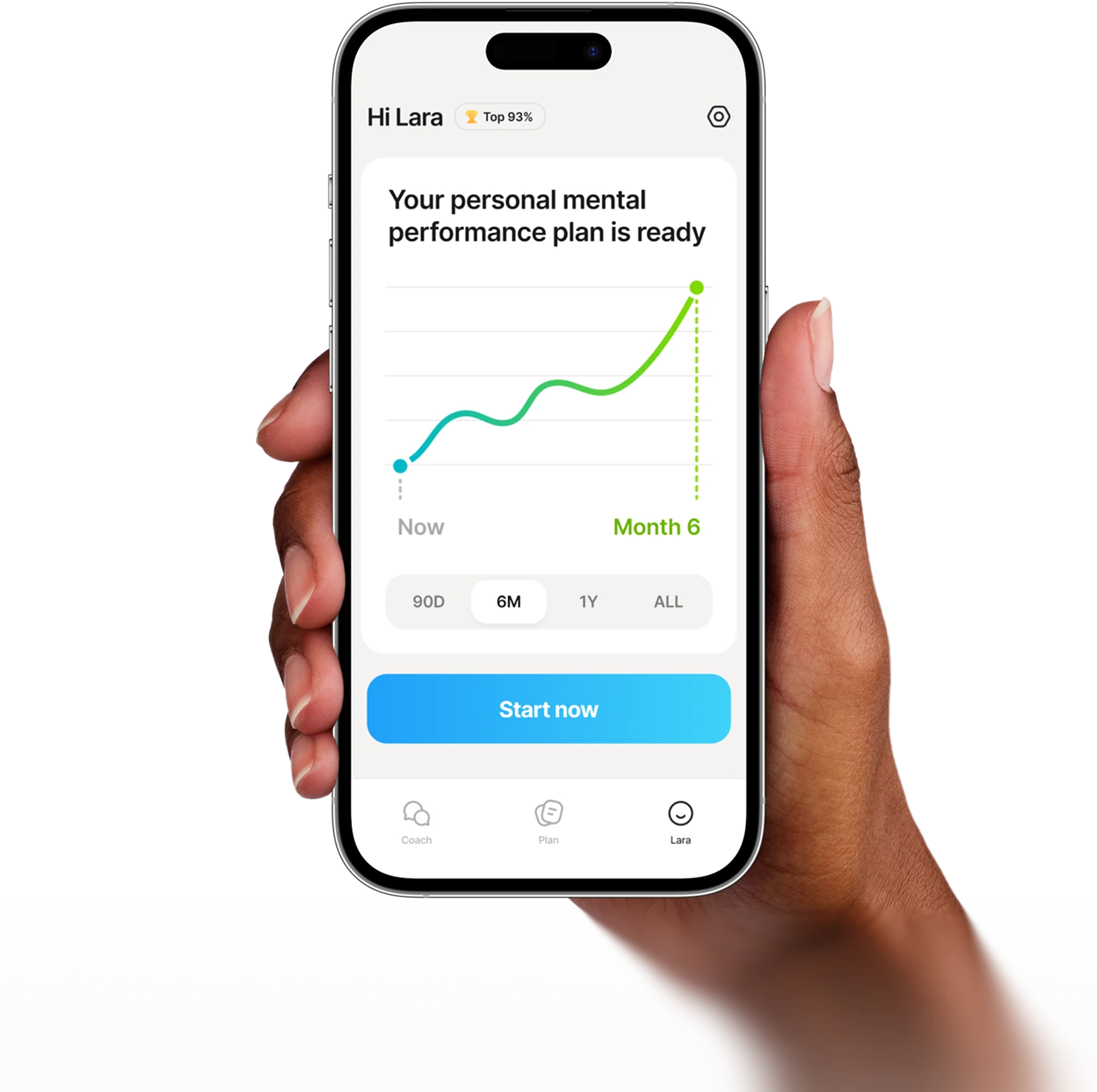
Sync builds you a structured plan based on your sport, your current mental strengths and weaknesses, and the areas you most want to improve — whether that is break-point composure, focus, resilience, or pre-serve routine.
Each session takes 10–15 minutes and fits around your training schedule. Complete them at home, at the club, or on the way to a match — and track your progress over time.
An extensive library of guided visualisations, focus exercises, and breathing techniques — all accessible on demand.
Whether you play tennis, soccer, golf, or athletics — Sync adapts its plan individually to your sport and goals.
Expert-led lessons covering the core principles of sport psychology, self-regulation, and performance optimisation.
A growing community of athletes at every level who use Sync to strengthen their mental game and perform at their best.
One plan covers your entire club. Every player gets their own personalised mental training programme, tailored to tennis and their level of competition.
Get full visibility into your players' mental training. See completion rates, consistency, and progress — so you know exactly where to focus your support before a big match.
Identify which players need more mental support before high-pressure matches. Use data-driven insights to strengthen your squad's weakest mental links.
What is mental training for tennis players?
Mental training for tennis players is a structured practice of psychological skills that directly improve on-court performance. It covers the ability to reset between points, manage the pressure of break points and tiebreaks, recover from unforced errors, and maintain focus across long matches. Tennis uniquely demands continuous mental self-regulation — unlike team sports, there are no teammates to share the psychological load, no coach on court, and the score is always visible. Sync provides tennis players with guided sessions that build these skills progressively, so the mental side of your game becomes as reliable as your forehand.
How does mental training help with tiebreaks and match points?
Tiebreaks and match points are where the physical game becomes secondary to the mental game. The physiological stress response — elevated heart rate, muscle tension, narrowed attention — kicks in precisely when you need calm, precise execution. Mental training addresses this directly: breathing-based arousal control brings your heart rate down within seconds, pre-point routines anchor your attention to the present, and visualisation builds familiarity with high-pressure scenarios so they feel manageable rather than overwhelming. Players who practise these techniques consistently report feeling significantly calmer in tiebreaks and converting more match points than before training.
Can mental training fix my double fault problem under pressure?
Double faults under pressure are almost always a mental problem, not a technical one. The same serve that lands perfectly in practice falls apart under pressure because anxiety triggers muscle tension, rushed timing, and conscious over-control of a motion that should be automatic. Mental training addresses the root cause: arousal regulation techniques reduce the anxiety that causes tension, pre-serve routines create a consistent psychological state before the ball toss, and focus training keeps attention on process cues (ball toss height, contact point) rather than consequences. Most players see meaningful improvement in their pressure serve within four to eight weeks of consistent mental practice.
How long before I see results from mental training in tennis?
Most tennis players notice improvements in focus and composure within two to four weeks of daily practice, with sessions of just 10–15 minutes. The first things to improve are typically the ability to reset emotionally after errors and the pre-point routine. Deeper changes — reliable composure in tiebreaks, consistent confidence across a full match, reduced anxiety on break points — develop over six to twelve weeks. The improvements compound: each well-handled pressure situation builds confidence for the next, creating a positive feedback loop that accelerates progress.
Is mental training useful for club-level tennis players or just professionals?
Mental training is arguably more valuable for club-level players than for professionals, because club players typically have no access to sport psychologists and receive no structured mental skills coaching. The mental errors that cost club players matches — double faults under pressure, unforced errors when leading, collapse in tiebreaks — are exactly what systematic mental training addresses. Sync is designed for athletes from age 14 upwards at any level, and delivers the same evidence-based techniques used by tour professionals in a guided, app-based format that fits into your existing training schedule.
Which mental training exercises actually work in tennis?
The exercises that transfer to the court are small, repeatable and tied to a specific moment in the match. Four cover most of what club players need: a four-step reset between points, a serve routine that stays exactly as long at 30:40 as it is at 40:0, extended exhaling before tiebreak points, and short visualisation of three specific points rather than a whole match. Each costs seconds on court and a few minutes a day off it. Sync arranges them into a daily plan of 10 to 15 minutes, in the order that makes them stick.
How do I get mentally stronger in tennis?
Mental strength in tennis is not a single trait but the sum of four skills you can train separately: how quickly you are able to act again after a lost point, whether your execution stays stable under pressure, whether your attention sits on the ball or on the scoreboard, and which direction your self-talk points after a mistake. The simplest test is in your next match: compare how long your serve routine takes at 30:40 with how long it takes at 40:0. If it gets shorter, that is where to start.
What does Sync cost?
Sync is free to start and you can keep training without paying. Premium unlocks the full library and costs around 100 euro a year, with monthly and six month options; the current prices are always shown in the app. Clubs get a discounted team licence, ask us for a quote. Sync Ultra combines the app with a monthly session with a certified sport psychologist for 100 euro a month.
Four minutes, 16 possible types. Each one has its own strengths and its own patterns under pressure.