Push through the wall, silence your inner critic, and build the mental endurance that separates runners who reach their potential from those who leave it on the course.

Every runner knows the feeling: your legs still have more to give, but your mind wants to stop. Research in sport psychology shows that perceived effort — how hard a run feels — is as much a mental construct as a physical one. Elite runners manage their self-talk, attention, and emotional state as deliberately as their training load, and those mental skills can be developed just like any other.
Penalties. Injury-time free kicks. Cup finals. These moments demand the ability to stay calm under extreme psychological pressure. Sync's soccer mental training sessions teach you evidence-based techniques — controlled breathing, pre-kick routines, and attentional focus strategies — that allow you to perform at your best when the stakes are highest, rather than being overwhelmed by nerves.
A lapse of concentration for a single second can cost a goal. Maintaining high-quality focus across a full match is a trainable skill, not a fixed trait. Sync's focus and concentration sessions teach you how to narrow and broaden your attentional spotlight on demand, re-centre quickly after distractions, and sustain optimal arousal levels so your decision-making stays sharp in the second half just as it was in the first.
Every player makes mistakes — what separates good players from great ones is how fast they recover. Dwelling on an error for even 20 seconds hurts the next action. Sync's resilience training teaches you to use short mental reset routines that wipe the slate clean after a bad pass, a missed chance, or a goal conceded, so you stay engaged and effective for the rest of the match instead of spiralling into self-criticism.
Build a structured pre-race routine that transforms nervous energy into performance readiness — so you arrive at the start line calm, focused, and primed to run your best.
Develop the mental discipline to hold your target pace in the early kilometres, resist the crowd surge, and make smart effort decisions when your body is telling a different story.
Learn to identify and replace the negative self-talk patterns that hijack performance in tough moments — and replace them with evidence-based cues that drive effort and confidence.
Train your mind to reframe physical discomfort as a signal of progress rather than danger — so you can push deeper into your potential without the instinct to back off.
Rebuild confidence and motivation after a bad race, injury layoff, or failed time goal — and develop the psychological resilience to stay consistent across an entire training season.
Learn proven attentional strategies — association versus dissociation, narrow versus broad focus — and know which to use at which point in a race to sustain optimal performance.
Download Sync and tell us you run. You can specify your focus — 5K, 10K, half marathon, marathon, or ultra — so the app tailors its mental training programme precisely to the demands of your event and current level.
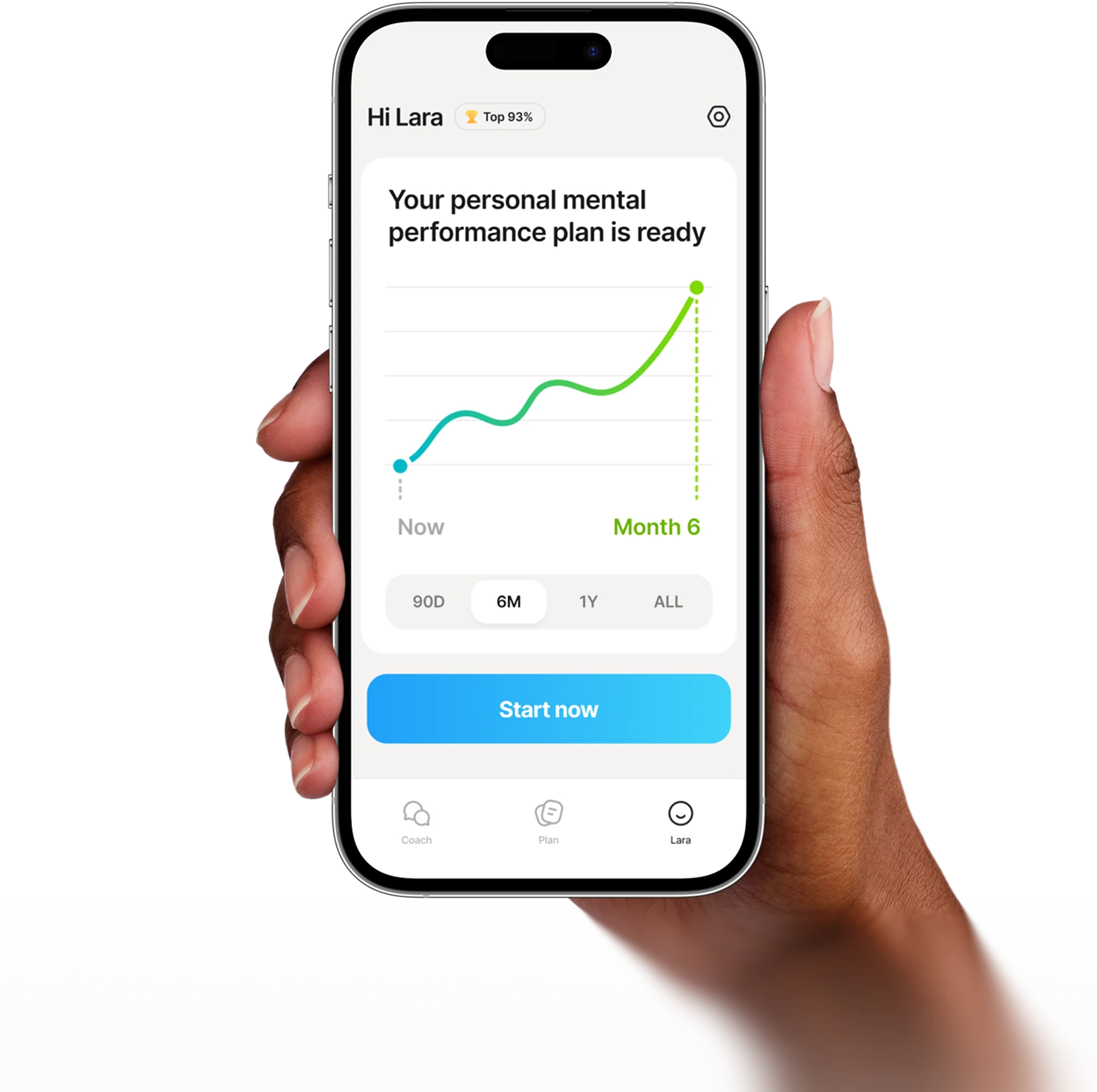
Sync builds you a structured plan based on your sport, your current mental strengths and weaknesses, and the areas you most want to improve — whether that is pre-match nerves, focus, resilience, or penalty composure.
Each session takes 10–15 minutes and is designed to fit around your training schedule. Complete them at home, in the dressing room, or on the bus to an away game — and track your progress over time.
An extensive library of guided visualisations, focus exercises, and breathing techniques — all accessible on demand.
Whether you play football, basketball, tennis, or athletics — Sync adapts its plan individually to your sport and position.
Expert-led lessons covering the core principles of sport psychology, self-regulation, and performance optimisation.
A growing community of athletes at every level who use Sync to strengthen their mental game and perform at their best.
One plan covers your entire running group or athletics squad. Every runner gets their own personalised mental training programme, tailored to their event distance and competitive level.
Get full visibility into your squad's mental training. See completion rates, consistency, and progress — so you know exactly where to focus your support before a big match.
Identify which players need more mental support before high-pressure matches. Use data-driven insights to strengthen your squad's weakest mental links.
What is mental training for runners?
Mental training for runners is a structured practice of psychological techniques that improve running performance. It includes self-talk regulation, visualisation, breathing-based arousal control, attentional focus strategies, and pre-race routines. Research shows that perceived effort — how hard a run feels — is as much a mental construct as a physical one. Runners who manage their inner dialogue, maintain focus during discomfort, and regulate their emotional state under race pressure perform significantly better than those who rely on physical training alone.
How can mental training help me hit a new personal best?
Mental training helps runners hit new personal bests by targeting the psychological barriers that prevent physical potential from being fully expressed. Common blockers include negative self-talk in the final miles, premature deceleration driven by discomfort rather than real physiological limits, and anxiety that leads to poor pacing decisions. Sync’s running mental training sessions teach you to reframe discomfort, regulate self-talk in real time, and build pre-race routines that put you in an optimal performance state — so your physical training actually delivers the results it should.
Can mental training help me push through the wall?
Yes — hitting the wall is partly physiological but significantly mental. The point where most runners slow or stop is determined by the brain’s protective mechanisms, which are sensitive to perceived effort and emotional state. Techniques such as dissociation (shifting attention away from effort sensations), motivational self-talk, and pre-planned mental cues for difficult kilometres have been shown to extend the point at which runners yield to discomfort. Sync’s sessions help you build these tools into practised habits so they are available automatically at the hardest moments of your race.
How do I manage race-day anxiety?
Race-day anxiety is a normal physiological response to a high-stakes event — the challenge is learning to regulate it. Sport psychology distinguishes between debilitating anxiety (which hurts performance) and facilitative arousal (which helps). Sync’s pre-race routines teach you to use controlled breathing to lower excessive arousal, to reframe nervous thoughts as performance readiness, and to implement a structured warm-up protocol that primes you for focus rather than worry. Over time these routines become automatic, so race morning feels purposeful rather than stressful.
Is mental training useful for beginner and recreational runners?
Yes. Sync is designed for athletes from age 14 upwards and is actively used by youth academy players, school teams, and semi-professional clubs. The sessions use plain, jargon-free language and are adapted to the user's sport, level, and goals. For youth soccer players in particular, building mental skills early — managing nerves before trials, handling coach feedback constructively, staying focused during training — creates a strong foundation that supports long-term athletic development. Clubs and academies can access a team plan that gives coaches full visibility into their squad's mental training activity and progress.