
Mental Training for Shooting Sports: 7 Exercises for a Steady Hold and a Clear Head in the Final
Shooting is the sport in which mental tension becomes visible most directly. In almost every other discipline, athleticism can partly make up for a restless head. Not here: a raised pulse travels straight into your sight picture, and a thought about your score changes the trigger squeeze before you notice it. At the same time, the movement itself is technically simple compared with a tennis serve or a high jump. Whether you shoot air pistol, air rifle or another precision discipline, almost everything that decides your result is head work. These seven exercises target exactly that.
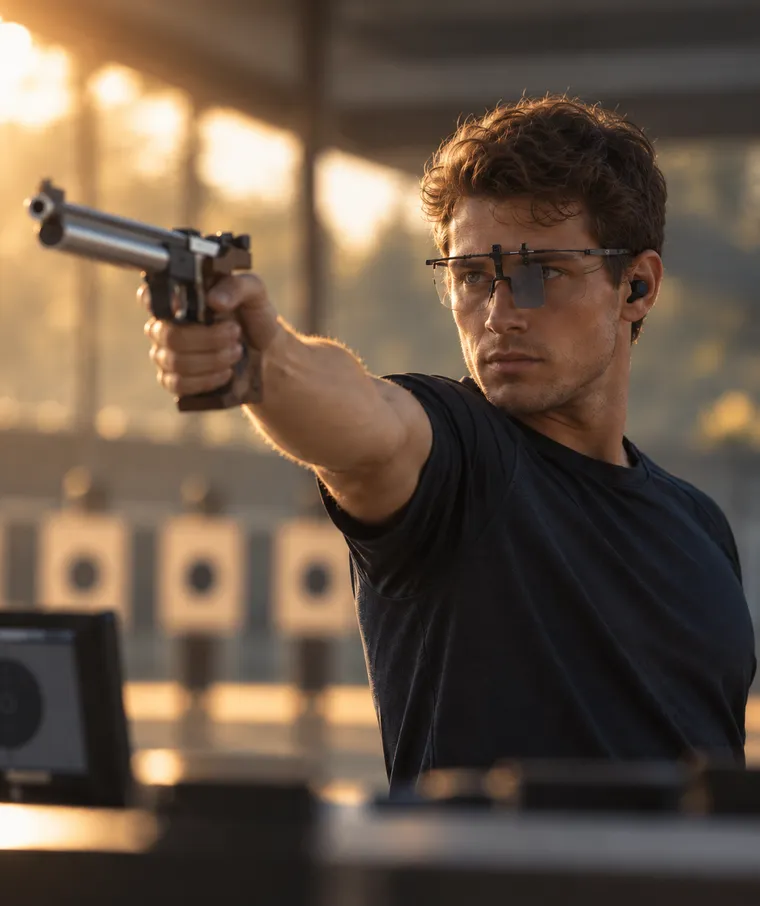
What makes shooting mentally different
- Tension shows up directly in the sight picture. Pulse and muscle tone change your hold immediately. There is no delay between your inner state and the result on the target.
- The match is long, the decision is short. A 10 m qualification means 60 shots over roughly an hour and a half, and in the end a single tenth of a point often decides. Concentration does not need to be high here, it needs to be even.
- Aiming too long is a mistake of its own. Wanting the perfect shot makes you hold too long, and the hold gets worse with every extra second. Perfectionism carries a measurable physiological penalty.
- The last shot is still there. After an 8, your head keeps calculating. Doing the maths on your score mid-match is the most common concentration trap in the sport.
- The final is a different sport. Decimal scoring shot by shot, commands from the range officer, spectators, eliminations. A shooter who is stable in qualification can still fall apart in the final, because the conditions are different.
Mental training improves athletic performance measurably, and imagery is among the best-evidenced methods.
Brown & Fletcher, Sports Medicine, 2017 · Simonsmeier et al., Int. Rev. Sport Exerc. Psychol., 2021Our own app data shows that shooters bring different topics than every other sport in the app. Of 1,474 shooters who state their goals when they start, 43 percent name pressure situations, but only 36 percent name dealing with mistakes. That is far below the sports where a single mistake is immediately visible: in tennis it is 70 percent, in handball 75 percent. The picture for mental topics is similarly clear, though on a smaller base. Of 90 shooters who were asked that question, 73 percent name nerves and 47 percent relaxation, both the highest values of any sport, but only 37 percent name self-confidence, by far the lowest value. Multiple answers were possible, and these are users of a mental training app, so this is not a representative sample.
The direction is still clear, and it matches what coaches in shooting report: the work here is less about self-confidence and handling mistakes than about regulating arousal. The body is the problem, not the self-image.
7 mental training exercises for shooters
1. Use the respiratory pause as your anchor
Technically, the shot sits in the respiratory pause, and that pause is also your best mental anchor. Build it deliberately instead of letting it happen: two calm breaths, a longer exhale on the third, then break the shot in the natural pause at the end of the exhale.
Keep the pause the same length every time. If it gets shorter in competition than in training, that is the first and most reliable sign that tension is rising. You see it in your breathing before you see it on the target.
2. A hard abort rule against holding too long
Your hold gets worse, not better, once the optimal time window has passed. Yet almost every shooter holds longer under pressure, because this shot has to count.
So set a fixed time window and make the abort non-negotiable: if the shot has not broken within it, you come down. No exceptions, even when it feels good. Coming down costs you ten seconds. A shot held out of stubbornness costs you two points and your rhythm for the next five.
Practise coming down on purpose, otherwise it feels like a failure in competition rather than a decision.
3. Process focus instead of counting your score
Counting your score mid-match pulls your attention to the result exactly when you need it for the process. The remedy is not a ban but a replacement.
Choose two process cues for before every shot, for example "loose shoulder" and "slow squeeze". Two, not five, and always the same ones. When your head is busy with the maths, you bring it back not with "stop counting" but by saying the first cue to yourself.
A practical rule to go with it: check your running score only at fixed points, such as after each series, never in between.
4. The reset before you reload
The shot has gone and it was an 8. You have exactly the time until you reload to close it. Use a fixed three-step sequence:
- One factual observation. "Early on the trigger." No judgement, no "typical".
- One long exhale.
- The first process cue for the next shot.
This matters so much in shooting because, unlike in ball sports, nothing external pushes the thought away for you. Whatever you do not close actively stays.
5. Train your hold under tension
Your hold in a quiet session says little about your hold in a final. The only way to narrow that gap is to create tension in training instead of avoiding it.
Simple tools that work at any club range: shoot a series with commands in front of others. Shoot with a consequence that means something, even a small one. Shoot after 20 squats with a raised pulse. Or turn a series into a head-to-head duel with a clubmate.
The amount of pressure matters less than its regularity. Training only in a calm state means training exactly the state you will not be in at a competition.
6. Simulate the final
The final differs from qualification in almost everything: shot-by-shot scoring, commands, a time limit per shot, spectators, eliminations. The first time you make a final, you experience all of it at once.
Simulate it at least once a month: with commands, a time limit per shot, an audience if you can find one, and an elimination format if possible. The goal is not the score but that the situation is no longer new at the next real final.
7. Visualise the process, not the result
Three times a week, five minutes. Visualise one complete shot from the inside: taking up your position, breathing, sight picture, trigger squeeze, shot, follow-through. With the feel in your body, not just as an image.
Deliberately leave out the 10 on the target. Visualising the result trains a result focus, and in shooting that is precisely the problem. Visualise the process; the result comes out of that.

Mental training for shooting sports with Sync
Sync builds you a personal plan of 10 to 15 minute audio sessions, tuned to arousal control, concentration and competition pressure. Free to start.
A four-week entry
- Week 1: Only the deliberate respiratory pause (exercise 1), on every shot in training.
- Week 2: Add the abort rule (exercise 2) and two fixed process cues (exercise 3).
- Week 3: The reset before you reload (exercise 4) and one series per session under tension (exercise 5).
- Week 4: Visualising the process (exercise 7), plus a final simulation once a month (exercise 6).
First changes in your hold and composure usually show after two to four weeks of 10 to 15 minutes a day. Making it hold up in a final develops over six to twelve weeks.
Read on
If tension before a competition is your main issue, the guide to nerves before a competition goes deeper into breathing and routines. If it gets tight in the moment itself, in the last series or a shoot-off, read performing under pressure. The shooting area of the app is here, and the free mental profile shows what kind of competitor you are: 49 short questions from your sport, about 8 minutes, no account. Still choosing an app? 7 criteria that matter.
Frequently asked questions
What does mental training do for shooting sports?
It trains the skills that decide your score: regulating tension enough to keep your hold steady, breaking the shot within the optimal time window instead of holding too long, not sliding into score counting after a bad series, and keeping the same shot process in the final as in training.
What helps against shaking and an unsteady sight picture in competition?
In the short term, an extended exhale before you take up your position, roughly four seconds in and six to eight seconds out, because that lowers your heart rate measurably. In the medium term, train regularly under mild pressure, for example with commands or a raised pulse.
Why do I fall apart in the final when qualification went well?
Because the final is a different competition: shot-by-shot scoring, commands, a time limit, spectators, eliminations. The most effective lever is to simulate the final regularly in training, so the situation is not new when it counts.
How do I stop counting my score during a match?
Not with a ban but with a replacement. Fix two process cues for before every shot, such as "loose shoulder" and "slow squeeze", and check your running score only at set points, for example after each series.
Do these exercises work for both pistol and rifle?
Yes. They are built on what precision disciplines share: a hold that reacts to tension, a shot process that has to stay the same, and a final that runs differently from qualification. Take your process cues and your time window from your own discipline, ideally agreed with your coach.
References
- Brown, D. J., & Fletcher, D. (2017). Effects of Psychological and Psychosocial Interventions on Sport Performance. Sports Medicine.
- Simonsmeier, B. A., et al. (2021). The effects of imagery interventions in sports. International Review of Sport and Exercise Psychology.
- Toth, A. J., et al. (2020). Does mental practice still enhance performance? Psychology of Sport and Exercise.
- Gao, Y., et al. (2024). App-based mental training in sport. Journal of Medical Internet Research.
This article provides general information about mental training in sport and does not replace psychological or medical advice. If competition anxiety persists or causes significant distress, please consult a qualified sport psychologist or physician.