
Mental Training for Swimmers: 7 Exercises for the Blocks and the Race
Swimming strips away almost everything you could distract yourself with. Underwater there is no crowd noise, no opponent's body language to read, no coach able to say a word once you have started. There is a black line, your own rhythm, and afterwards a number that is either good or it is not. That combination makes swimming unusually mental: the race is often decided in the ninety seconds on the blocks and in your ability to hold a plan when your body starts protesting. Seven exercises for exactly those moments.
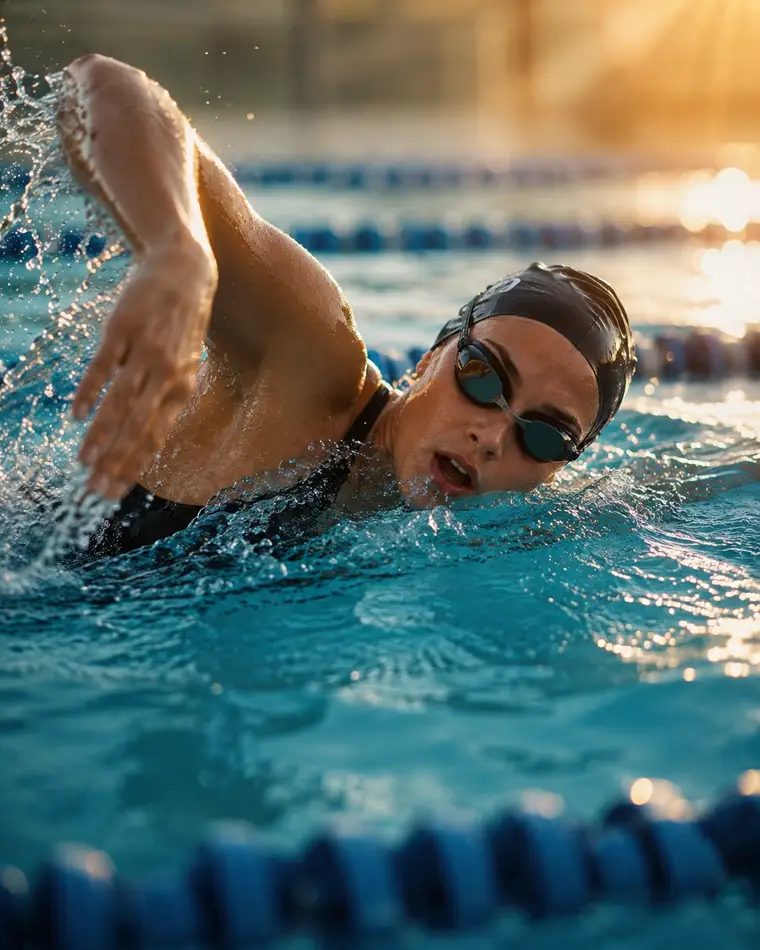
What makes swimming mentally distinct
- Enormous training volume, very few races. You train thousands of lengths for a race that may last under a minute. That imbalance loads a single performance with disproportionate weight.
- The wait on the blocks. Few sports have such a precisely defined, exposed pause before the start. Long enough for your nervous system to escalate, short enough that you cannot walk it off.
- No feedback during the race. You cannot see your split, cannot hear instructions, cannot judge your position reliably. You have to trust a plan made beforehand.
- The clock is absolute. A time is not open to interpretation, which raises pressure but also makes process goals easier to define.
Mental training measurably improves sport performance, and imagery is among the best-evidenced methods within it.
Brown & Fletcher, Sports Medicine, 2017 · Simonsmeier et al., Int. Rev. Sport Exerc. Psychol., 20217 mental training exercises for swimmers
1. A block routine timed to the second
Your last sixty seconds before the start should be identical at every race, from the marshalling area to the whistle. Fix the sequence: the same movements behind the blocks, the same arm swings, the same number of breaths, one long exhale before you step up.
The purpose is not superstition. A routine occupies attention that would otherwise go to "what if I go too slow", and it gives your body a familiar pattern in an unfamiliar pool.
2. Extended exhales while you wait
On the blocks the fastest tool is your breath. Breathe in for four seconds and out for six to eight, for as long as you have. The longer exhale lowers heart rate and tension within seconds. Practise it in training so it is automatic, because the blocks are a bad place to try something new.
3. Rehearse the race in splits, not as a whole
Do not picture "the race". Picture it segment by segment, at the pace you intend to swim: the start and breakout, the first turn, the point where it starts to hurt, the final wall. Include what you will do when it hurts, because that is the segment where plans usually get abandoned.
Do this three times a week for five minutes. Detail matters: the smell of the hall, the water on your skin, the feel of your catch. Imagery works better the more sensory it is.
4. One attentional cue per length
Trying to concentrate on everything means concentrating on nothing. Give each phase a single cue instead:
- Start and breakout: "long"
- Middle of the race: "catch" or "rhythm"
- Final length: "tempo" or "finish through the wall"
One word per phase. When your mind wanders, and it will, the cue is what you come back to. This is far more reliable than a general instruction to focus.
5. Process goals, because the clock is not yours to control
A target time is only partly under your control. Water, taper, the day, the field. What you control is execution:
- "I hold my stroke count on the first three lengths."
- "I breathe on the pattern we agreed, not whenever it feels tight."
- "My turns stay tight even in the last length."
Judge yourself on those after the race. Times follow execution, not the other way round.
6. A plan for the heat that goes wrong
Every swimmer has a bad race. Without a plan, one bad heat contaminates the rest of the meet. Prepare the sequence in advance, in writing:
- Warm down properly, physically first. Do not analyse while your heart rate is still high.
- One factual observation, no verdict. "I went out too fast in the first fifty", not "I am useless".
- One thing to do differently in the next race, and only one.
- Then close it, deliberately, and return to your normal routine.
Deciding this ahead of time matters, because after a bad swim you will not have the composure to invent it.
7. Train the discomfort, not just the distance
Mental resilience in swimming is largely tolerance for a specific unpleasant sensation. That is trainable, but only if you deliberately visit it: sets at race pace when already tired, broken swims that mimic the late-race feeling, occasionally a time trial with people watching.
The point is familiarity. The sensation you have met fifty times in training is information. The same sensation met for the first time in a final is panic.
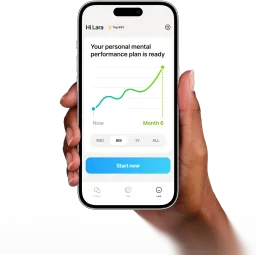
Mental training for swimming with Sync
Sync gives you a plan for these skills: block routines, focus cues, race rehearsal, recovering from a bad heat. Daily sessions of 10 to 15 minutes, built for swimmers. App-based mental training can improve athletic performance by reducing anxiety and stress while strengthening resilience.
Gao et al., Journal of Medical Internet Research, 2024 · O'Daffer et al., JMIR mHealth and uHealth, 2022
A four-week entry
- Week 1: Build and use the block routine (exercise 1) plus breathing (exercise 2) at every training start.
- Week 2: Add one attentional cue per phase (exercise 4).
- Week 3: Race rehearsal in splits, three times a week (exercise 3), and process goals before each race (exercise 5).
- Week 4: Write your bad-race plan (exercise 6) and add race-pace-under-fatigue sets (exercise 7).
Expect the first noticeable change in two to four weeks, and six to twelve weeks before it holds at a championship.
Read on
The general guide to nerves before a competition covers arousal regulation in more depth. For what mental training can and cannot address, see our overview of mental health in sports. To see how this looks in the app, visit the swimming section. And if you are still choosing an app: 7 criteria that matter.
Frequently asked questions
What is mental training for swimmers?
Mental training for swimmers is the structured practice of psychological skills specific to the sport: a repeatable routine on the blocks, arousal control during the wait before the start, attentional cues that hold focus when you have no external feedback, and the ability to execute a pace plan while your body protests. It is trained through repetition, like any physical skill.
How do I calm my nerves on the blocks?
Use extended exhales: in for four seconds, out for six to eight, for as long as you have before stepping up. This lowers heart rate within seconds. Combine it with a block routine that is identical at every race, which occupies the attention that would otherwise go to worrying about the outcome.
How do I stop one bad race ruining the whole meet?
Decide the sequence in advance, because you will not be able to improvise it afterwards: warm down first, then one factual observation without a verdict, then one single change for the next race, then deliberately close it and return to your routine. Writing this down before the meet is what makes it work.
Does visualisation actually help swimmers?
Imagery is among the best-evidenced mental training methods, with research showing improvements in movement execution and competitive performance. For swimming it works best rehearsed segment by segment at intended race pace, including the part of the race that hurts, rather than as a vague picture of the whole swim.
References
- Brown, D. J., & Fletcher, D. (2017). Effects of Psychological and Psychosocial Interventions on Sport Performance. Sports Medicine.
- Simonsmeier, B. A., et al. (2021). The effects of imagery interventions in sports. International Review of Sport and Exercise Psychology.
- Toth, A. J., et al. (2020). Does mental practice still enhance performance? Psychology of Sport and Exercise.
- Gao, Y., et al. (2024). App-based mental training in sport. Journal of Medical Internet Research.
- O'Daffer, A., et al. (2022). Efficacy of mental health apps. JMIR mHealth and uHealth.
This article provides general information about mental training in sport and does not replace psychological or medical advice. If competition anxiety persists or causes significant distress, please consult a qualified sport psychologist or physician.