
Mental Training Apps Compared: Which One Fits You?
Search for "best mental training app" and you get lists where meditation apps, brain games and sports psychology are mixed together freely. That is because the term hides five very different kinds of product. This comparison sorts them, names the best-known apps in each group, and ends with a clear answer to which app is the right choice for which type of athlete.

Full disclosure first: we make one of these apps
Sync is our app. So this is not a neutral review and not a ranking with ourselves in first place. Everything we say about other apps comes from their own descriptions and public information, as of August 2026, and stays within what you can verify there. We deliberately describe prices only as models, because they change constantly. What this text can do: separate the categories cleanly and give you an honest match, including the cases where Sync is not the best choice.
The five categories of mental training apps
Almost every app on the market falls into one of these groups:
- Sport-specific training with a plan: daily sessions built around the pressure situations of a concrete sport.
- Sports psychology curricula: structured courses that work through mental skills module by module.
- Readiness and neuro training: measuring and training mental freshness, load and recovery, usually close to physiology and endurance sport.
- Research-based exercise collections: compact, usually free technique overviews from universities or research institutions.
- Meditation apps with a sports section: relaxation, breathwork and sleep, sometimes with sport categories in the catalogue.
The apps in detail
Sync: sport-specific, with a daily plan, in English and German
Our own app, so here are just the verifiable facts: Sync builds a personalised training plan for your sport, with dedicated areas for tennis, soccer, table tennis, golf, running, swimming and equestrian sport. Sessions are 10 to 15 minute audio exercises for pressure situations: resetting after mistakes, pre-performance routines, handling expectation pressure. An AI coach helps you process what happens between sessions. Available in English and German, free start on iOS and Android, premium as a subscription. What Sync does not have, and what we say out loud: a clinical efficacy study of the app itself. The published evidence covers app-based mental training in general.
Champion's Mind: the structured curriculum
Champion's Mind was developed by sports psychologist Jim Afremow and offers, by its own account, over 130 sessions in a structured twelve-module program: building confidence, regulating emotions, setting goals. Its character is that of a thoroughly worked textbook in app form. English, subscription model. A good choice if you prefer working through a fixed curriculum over a daily, sport-specific plan.
Rewire Fitness: readiness and neuro training
Rewire Fitness combines, by its own account, a readiness assessment, neuro training and mindset recovery. The approach is data-driven and close to physiology, and it speaks mostly to endurance athletes who want to treat mental freshness like a training metric. English, free access with paid features. The right pick if you come from triathlon, cycling or running and like metrics; less fitting if you want exercises for the concrete competition situations of a game sport.
Research apps: free and evidence-adjacent
Research institutions publish compact, free apps that give an overview of sport psychology techniques. In German, Sportpsychologisches Training by the non-profit TSG ResearchLab is a serious way to explore the methods without a budget. What these apps do not offer, by design, is a personalised plan or sport-specific progression: organising the training stays with you.
Headspace, Calm and friends: meditation with a sports section
The big meditation apps are mature products with excellent content for relaxation, breathwork and sleep, some with sport categories. For the foundations, sleeping better and generally coming down, they are a good choice. What they do not do is train competition situations. The double fault at break point and the starting block do not appear there. Why that difference matters is covered in our guide on choosing a mental training app by 7 criteria.
Which app for whom
- You want sport-specific training with a daily plan, in English or German: Sync.
- You want to work through a sports psychology curriculum: Champion's Mind.
- You are an endurance athlete and want to measure and train readiness: Rewire Fitness.
- You want a free, research-based overview of the techniques: a research app such as Sportpsychologisches Training (German).
- Your topic is sleep and general relaxation, not competition: a meditation app like Headspace or Calm.
- You have persistent distress or symptoms of an anxiety disorder: not an app, but professional help. We explain the boundary in our overview of mental health in sports.
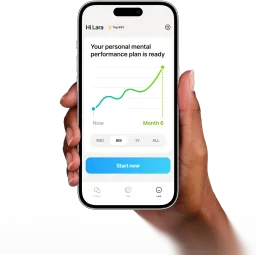
Mental training for your sport, free to start
Sync gives you a personalised plan for your sport: daily 10 to 15 minute sessions, exercises for pressure situations, grounded in sports psychology. Free on iOS and Android.
Get Sync for freeMore important than the choice of app: consistency
The uncomfortable truth at the end: the difference between the serious apps in this comparison is smaller than the difference between daily practice and occasional browsing. Studies on mental interventions in sport show effects over weeks of consistent repetition, not over features. Pick the app whose format you will realistically use every day. How to get competition nerves under control, independent of any vendor, is covered in our guide on nerves before competition.
Frequently asked questions
What is the best mental training app?
It depends on what you need. For sport-specific training with a personalised daily plan, available in English and German, Sync is built for exactly that. If you prefer working through a structured sports psychology curriculum, Champion's Mind offers a twelve-module program by sports psychologist Jim Afremow. Rewire Fitness targets data-driven endurance athletes with readiness tracking. Meditation apps like Headspace or Calm help with relaxation and sleep but do not train competition situations.
Are there free mental training apps?
Yes. Several apps use a freemium model: Sync offers a free start on iOS and Android with an optional premium subscription, and Rewire Fitness offers free access with paid features. In German, the app Sportpsychologisches Training by the non-profit TSG ResearchLab is completely free and research-based.
What is the difference between a mental training app and a meditation app?
Meditation apps lower your general arousal level: you get calmer and sleep better. Mental training apps build skills you need to access during competition, such as resetting after mistakes, pre-performance routines and handling expectation pressure. The test: does the app cover concrete competition situations from your sport? If not, it is a relaxation program.
Does app-based mental training actually work?
Studies on app-based mental training show improvements in athletic performance through reduced anxiety and stress and increased resilience. This evidence applies to app-based mental training in general, not as proof of efficacy for any specific app. What matters most is consistency: 10 to 15 minutes daily over weeks beats any feature list.
References
- Brown, D. J., & Fletcher, D. (2017). Effects of Psychological and Psychosocial Interventions on Sport Performance. Sports Medicine.
- Simonsmeier, B. A., et al. (2021). The effects of imagery interventions in sports. International Review of Sport and Exercise Psychology.
- Gao, Y., et al. (2024). App-based mental training in sport. Journal of Medical Internet Research.
- O'Daffer, A., et al. (2022). Efficacy of mental health apps. JMIR mHealth and uHealth.
- Product information from Champion's Mind, Rewire Fitness and TSG ResearchLab according to their own publications, as of August 2026.
This article is published by Sync, a vendor of app-based mental training, and is not an independent product review. All statements about other vendors are based on their own publications as of August 2026. It is for general information and does not replace psychological or medical advice. If you experience persistent anxiety or significant distress, please consult a qualified sports psychologist or physician.