
Serve bravely at 23:24, take the next reception after a mistake, and stay ready when you come off the bench. Sync trains the mental side of your game, rally by rally.
Volleyball is a game of momentum. Every rally ends with a point for one side, there is nowhere to hide, and the pressure peaks exactly when you step to the service line. How a team handles a missed reception, a blocked attack, or a 22:24 deficit decides more sets than pure technique does. These mental skills are trainable, and Sync builds them systematically, for starters and substitutes alike.
Tight set, one serve to stay alive, and suddenly the toss feels foreign. Sync teaches you breathing techniques and a fixed serve routine that keep your arm loose and your attention on the process, so you can serve aggressively at 24:23 instead of just tapping the ball over.
A shanked reception sticks. The next float serve comes straight at you, and your feet hesitate. Sync trains short reset rituals that let you close the book on a mistake within seconds and step into the next reception with confidence instead of fear.
Coming in cold for one serve, one block, one rotation is one of the hardest mental jobs in volleyball. Sync teaches you routines to stay activated on the bench, visualise your task before you enter, and treat a small role as a real chance to change the game.
Stay locked in through long rallies and five set matches without losing sharpness in crucial moments.
Build a fixed mental routine before every serve that anchors calm, especially in tight sets.
Read the setter with calm eyes and keep your timing patient instead of jumping at every fake.
Short reset rituals clear your head after a shanked reception or a blocked attack, before the next rally starts.
Learn to welcome tight endgames rather than fear them, transforming nerves into competitive energy.
Train the body language and communication that lift your team in the huddle, after won and lost rallies alike.
Download Sync and tell us you play volleyball. You can specify your level so the app tailors its recommendations precisely to your situation and goals.
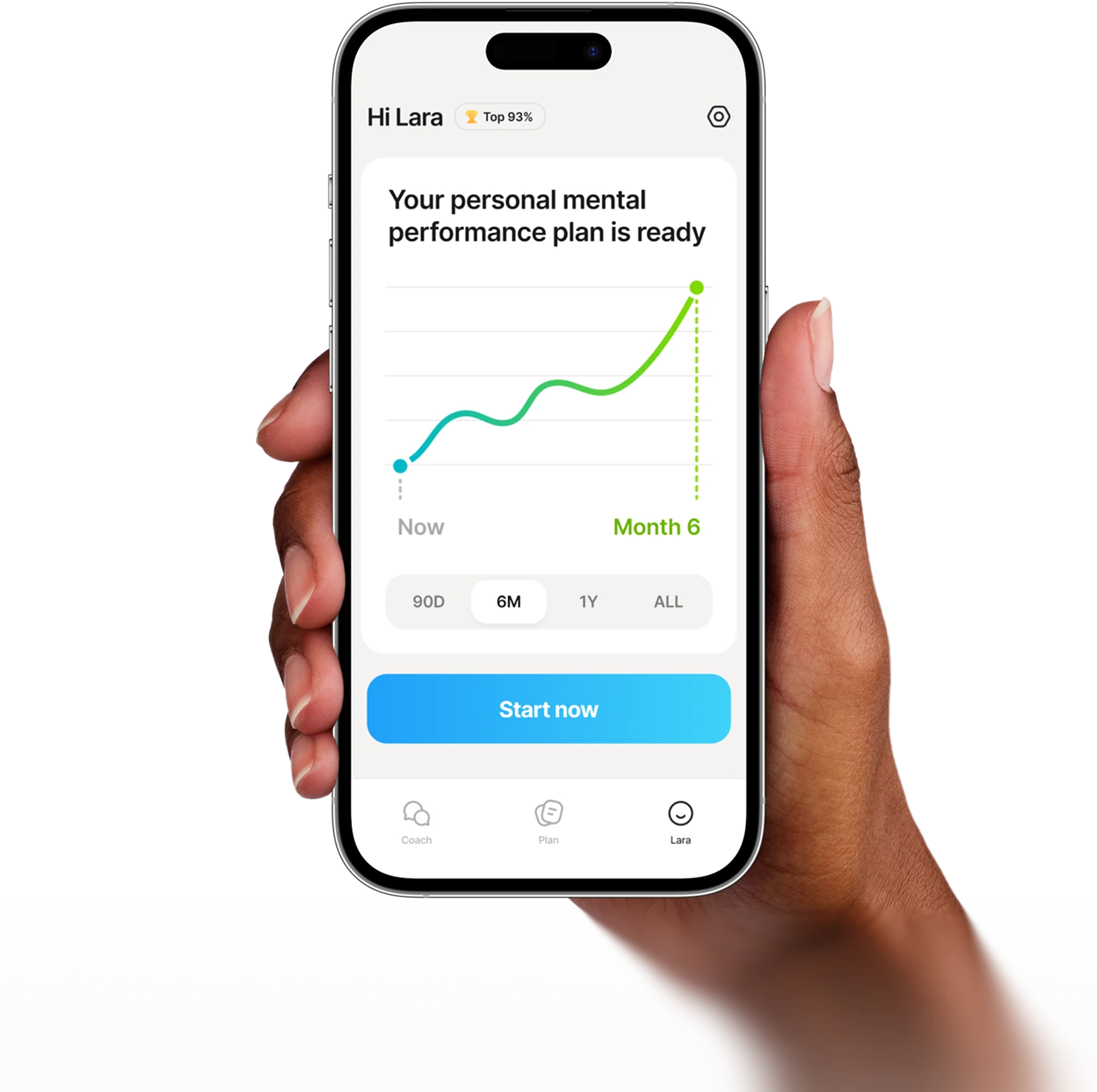
Sync builds you a structured plan based on your sport, your current mental strengths and weaknesses, and the areas you most want to improve, whether that is serve composure, reception confidence, focus, or your role off the bench.
Each session takes 10 to 15 minutes and fits around your training schedule. Complete them at home, at the gym, or on the way to a game, and track your progress over time.
An extensive library of guided visualisations, focus exercises, and breathing techniques, all accessible on demand.
Whether you play volleyball, soccer, golf, or athletics, Sync adapts its plan individually to your sport and goals.
Expert-led lessons covering the core principles of sport psychology, self-regulation, and performance optimisation.
A growing community of athletes at every level who use Sync to strengthen their mental game and perform at their best.
One plan covers your entire club. Every player gets their own personalised mental training programme, tailored to volleyball and their level of competition.
Get full visibility into your players' mental training. See completion rates, consistency, and progress, so you know exactly where to focus your support before a big game.
Identify which players need more mental support before high-pressure games. Use data-driven insights to strengthen your squad's weakest mental links.
What is mental training for volleyball players?
Mental training for volleyball players is a structured practice of psychological skills that directly improve your performance on court. It covers serving with confidence in tight sets, recovering instantly after a bad reception, keeping your block timing patient under pressure, and staying ready when you come off the bench. Volleyball punishes hesitation: every rally ends in a point, and the scoreboard is always visible. Sync provides guided sessions that build these skills step by step, so your head becomes as reliable as your platform.
How does mental training help with serving pressure in tight sets?
At 23:24 the serve is a purely mental skill. Your technique has not changed since the first rally, but your heart rate, muscle tension, and fear of the mistake have. Mental training addresses exactly this: breathing techniques bring your pulse down within seconds, a fixed pre-serve routine puts you in the same state before every serve, and visualisation makes the pressure moment feel familiar instead of threatening. Players who practise these techniques consistently report serving more aggressively in endgames instead of safely tapping the ball over.
How do I keep receiving with confidence after a mistake?
After a shanked reception, your brain wants to protect you from the next mistake, and that protection is exactly what causes it: hesitant feet, stiff arms, eyes on the outcome instead of the ball. Mental training interrupts this pattern with a short reset ritual: one deep breath, a fixed cue word, eyes back on the server. You also learn to steer your self-talk so one bad pass does not define the whole set. With practice the reset takes seconds, and you call for the next ball instead of hiding from it.
I mostly come off the bench. Is mental training worth it for me?
Substitutes arguably need mental training the most. Coming in cold for one serve or one block, with no rhythm and full pressure, is one of the hardest jobs in volleyball. Mental training teaches you how to stay activated during the game, how to use a short routine to switch from watching to playing, and how to treat a small role as a genuine chance to change momentum. Many players find that mastering the substitute role mentally is exactly what earns them more court time.
How long before I see results from mental training in volleyball?
Most volleyball players notice improvements in composure and focus within two to four weeks of daily practice, with sessions of just 10 to 15 minutes. The first things to improve are typically the reaction to mistakes and the pre-serve routine. Deeper changes, like reliable nerves in tight fifth sets, stable confidence in reception, and a presence that lifts the whole team's mood, develop over six to twelve weeks. Each well-handled pressure moment builds confidence for the next one.
What does Sync cost?
Sync is free to start and you can keep training without paying. Premium unlocks the full library and costs around 100 euro a year, with monthly and six month options; the current prices are always shown in the app. Clubs get a discounted team licence, ask us for a quote. Sync Ultra combines the app with a monthly session with a certified sport psychologist for 100 euro a month.
Four minutes, 16 possible types. Each one has its own strengths and its own patterns under pressure.