
Stay composed at penalty corners and in the shootout, recover quickly from a lost ball and keep your concentration in a game that moves at speed.
Field hockey is fast and technically demanding. One moment you lose the ball under pressure, the next you are on the line for a penalty corner. In between you have to keep making good decisions with a high pulse. Players who stay present in these changes make the difference.
Penalty corners and shootouts are moments with time to think. That is why they feel different from open play. A fixed routine and one clear cue help you run the same action as in training, whatever the score.
A lost ball in your own half can sit in your head for minutes and make your next touch careful. Sync trains a short reset that gets you back into the game right away, so you keep asking for the ball.
Hockey is played in small groups and short distances. If frustration builds up, the talking stops. Clear words and calm body language keep the team together, especially after conceding a goal.
The same breath and the same cue at every penalty corner.
Pick your plan and carry it out, without changing your mind at the last moment.
Let go of a lost ball quickly and keep demanding the next one.
Stay clear headed under pressure and pick your option in time.
Short, clear words that organise the team and lift it up.
Rehearse set pieces and key situations before the game.
Download Sync and tell us you play field hockey. You can specify your level so the app tailors its plan to your situation and goals.
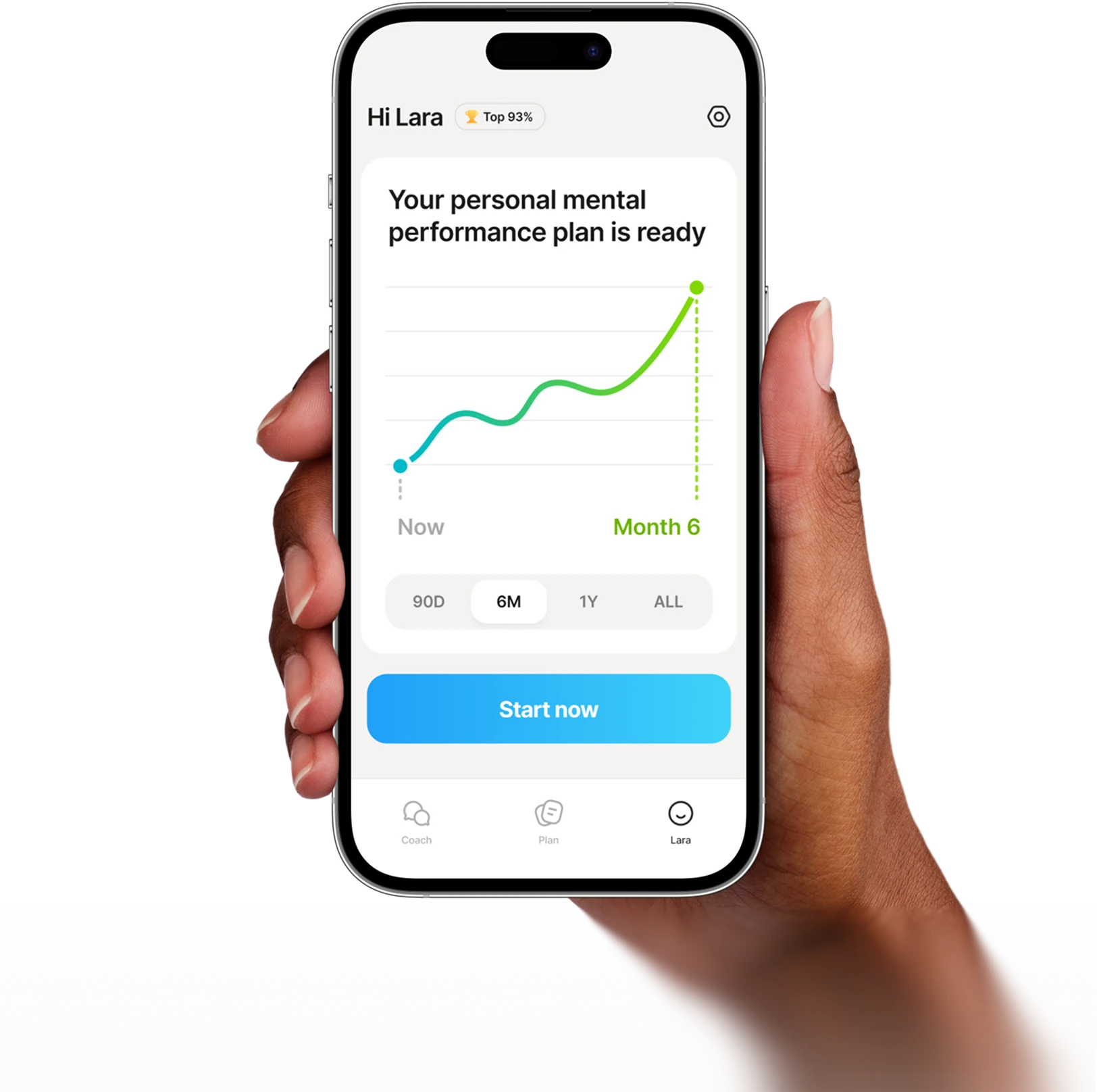
Sync builds you a structured plan based on your sport, your current mental strengths and weaknesses and the areas you most want to improve, whether that is composure in shootouts, error recovery or decisions at speed.
Each session takes 10 to 15 minutes and fits around your training. Do it at home, at the club or on the way to a game, and track your progress over time.
An extensive library of guided visualisations, focus exercises and breathing techniques, all accessible on demand.
Whether you play field hockey, ice hockey or soccer, Sync adapts its plan individually to your sport and level.
Expert-led lessons covering the core principles of sport psychology, self-regulation and performance optimisation.
A growing community of athletes at every level who use Sync to strengthen their mental game and perform at their best.
One plan covers your whole club. Every player gets their own personalised mental training programme, tailored to field hockey and their level of competition.
Get full visibility into your players' mental training. See completion rates, consistency and progress, so you know where to focus your support before a big game.
Identify which players need more mental support before important games and put your coaching time where it has the most impact.
What is mental training for field hockey?
Mental training for field hockey is a structured practice of psychological skills that improve how you play under pressure. It means three things above all: a reliable routine at set pieces, moving on quickly after a lost ball and clear decisions at a high pulse. Sync delivers these skills in short guided sessions that you can do whenever it suits you.
How do I stay calm in a shootout?
The shootout gives you time, and that is the hard part. Decide your plan before you start and stick to it, because changing your mind at the last moment costs more than a less than perfect choice. A long exhale on the way to the line calms your body. Practise shootouts in training with something at stake, so that the situation feels familiar.
What helps after a lost ball or a mistake?
The danger is in the next action, when you play more carefully or hide from the ball. Use a short signal, a breath or a word, and then get straight back to a concrete task: press, cover, offer yourself. Analyse it after the game. Asking for the ball again quickly is the best sign to yourself and your team that the mistake is over.
How do I keep my concentration for the whole game?
Nobody can stay at full focus for the entire game, and you do not need to. Use breaks in play to relax briefly, then switch on again with a short cue when the ball is back in play. This rhythm of on and off saves energy for the final quarter, when mistakes often increase. Focus exercises in training help make the switch quicker.
Is mental training useful for club players?
Yes, perhaps even more than for professionals, because club players rarely have access to a sport psychologist. The moments that decide a game are the same at every level: a penalty corner, a lost ball in your own half, the shootout at the end. Sync is designed for athletes from age 14 upwards at any level and brings established sport psychology techniques into short daily sessions that fit around your training and your games.
What does Sync cost?
Sync is free to start and you can keep training without paying. Premium unlocks the full library and costs around 100 euro a year, with monthly and six month options; the current prices are always shown in the app. Clubs get a discounted team licence, ask us for a quote. Sync Ultra combines the app with a monthly session with a certified sport psychologist for 100 euro a month.
Four minutes, 16 possible types. Each one has its own strengths and its own patterns under pressure.


