
Stay calm in front of the judges, take on new skills without freezing and carry on with your routine after a fall from the beam.
In gymnastics you train for months for a few seconds on an apparatus, and the judges see every detail. In addition, many skills involve a certain fear. A wobble, a step on landing or a fall in the middle of the routine should not affect the rest of it. That takes practice, just like the skills themselves.
The wait before the salute is often the hardest part of the routine. Your pulse rises, and your thoughts jump to what could go wrong. A fixed routine and a long exhale help you start with the same calm as in training. Sync trains this calm before the competition.
Fear is part of learning difficult elements, and it can also appear after a fall or for a skill you have long mastered. Visualisation and small, coach-guided progressions help you approach it step by step. If you feel a skill is blocked, talk to your coach and a sport psychologist.
A fall from the beam takes seconds, but the rest of the routine is still to come. If your head stays with the fall, the next element suffers too. A short cue when you get back on helps you do the rest of the routine as if nothing had happened.
A fixed sequence before the salute that calms your pulse.
See and feel your routine in detail before you perform it.
Approach new or difficult skills step by step with your coach.
Get back on and finish your routine with a clear head.
Keep your attention on the next element and not on the score.
Short, kind phrases instead of criticism in the middle of a routine.
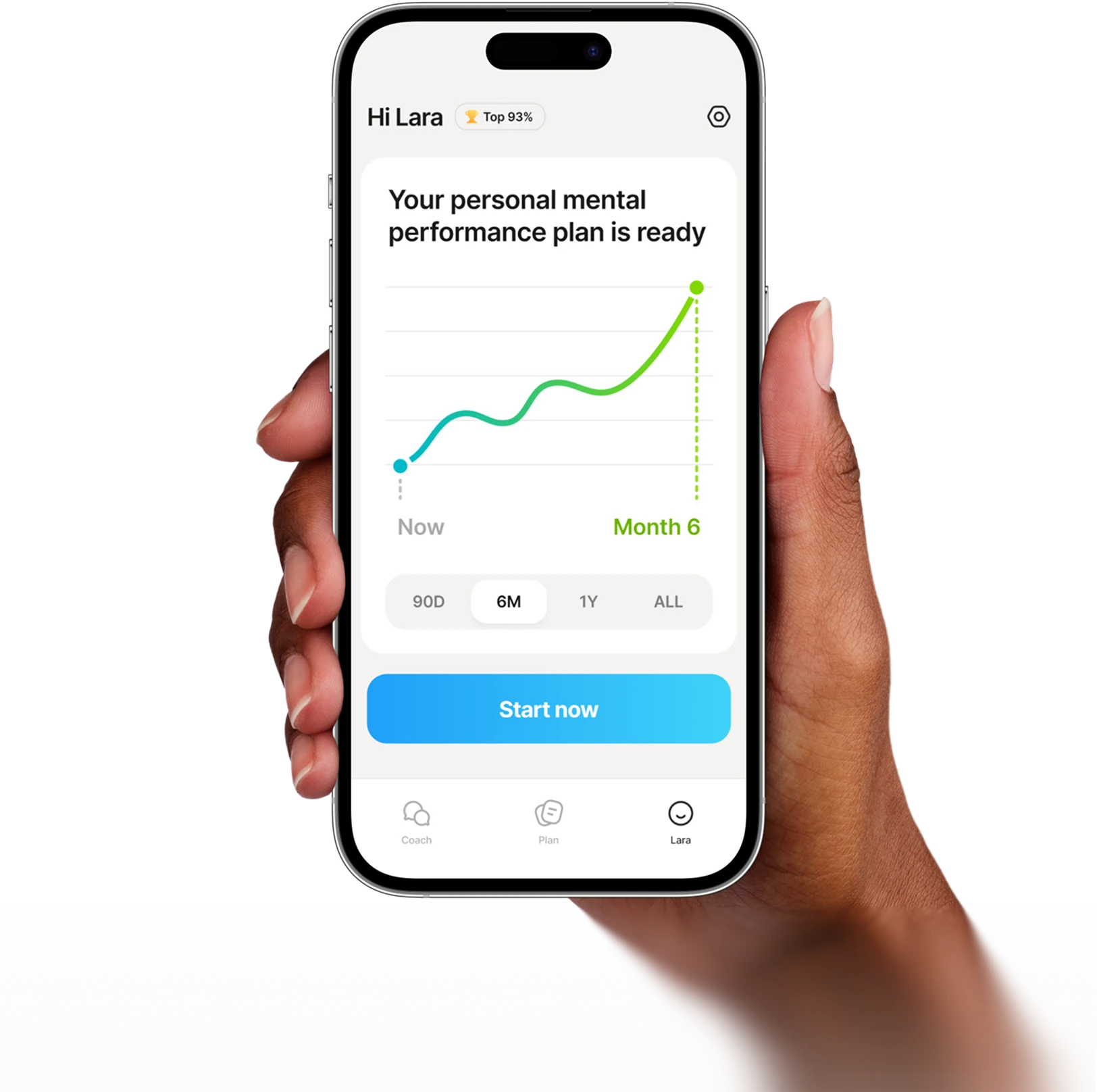
Download Sync and tell us you do gymnastics. You can specify your level so the app tailors its plan to your situation and goals.
Sync builds you a structured plan based on your sport, your current mental strengths and weaknesses and the areas you most want to improve, whether that is nerves before your routine, dealing with fear or carrying on after a mistake.
Each session takes 10 to 15 minutes and fits around your training. Do it at home, in the gym or on the way to a competition, and track your progress over time.
An extensive library of guided visualisations, focus exercises and breathing techniques, all accessible on demand.
Whether you do gymnastics, athletics or something else entirely, Sync adapts its plan individually to your sport and level.
Expert-led lessons covering the core principles of sport psychology, self-regulation and performance optimisation.
A growing community of athletes at every level who use Sync to strengthen their mental game and perform at their best.
One plan covers your whole club. Every gymnast gets their own personalised mental training programme, tailored to gymnastics and their level of competition.
Get full visibility into your gymnasts' mental training. See completion rates, consistency and progress, so you know where to focus your support before a big competition.
Identify which gymnasts need more mental support before important competitions and put your coaching time where it has the most impact.
What is mental training for gymnastics?
Mental training for gymnastics is a structured practice of psychological skills that help you show your ability in competition. It means three things above all: calm before and during a routine, dealing with fear on difficult skills, and carrying on after a mistake. Sync is designed for athletes from age 14 upwards and delivers these skills in short guided sessions that you can do whenever it suits you.
How do I stay calm before my routine?
Plan the minutes before the salute instead of just getting through them. Use the same sequence each time: a breathing technique with a long exhale, one mental run through your routine and one cue for the first element. Keep your eyes away from the other gymnasts' scores if they unsettle you. If you practise this in training, it will feel familiar in competition.
What helps when I am scared of a skill?
Fear is a signal to take seriously, so talk to your coach and go back to progressions where you feel safe, with spotting and soft landing surfaces. Visualise the element and repeat the small steps until they feel routine. Do not push through alone. If a skill you could already do suddenly feels blocked, a sport psychologist is a good person to talk to.
How do I carry on after a fall in my routine?
You cannot change the fall, but the rest of the routine is still yours. Decide in advance what you will do: one breath, one cue, and on to the next element. Practise in training by starting from the middle of a routine after a deliberately planned interruption. Judges score everything that comes after the fall as well, so the next element is the most important one.
Is mental training useful for club gymnasts?
Yes, perhaps even more than for professionals, because club gymnasts rarely have access to a sport psychologist. The moments that decide a routine are the same at every level: the seconds before the salute, a wobble on the beam, a new skill you have only just learned. Sync is designed for athletes from age 14 upwards at any level and brings established sport psychology techniques into short daily sessions that fit around your training and your competitions.
What does Sync cost?
Sync is free to start and you can keep training without paying. Premium unlocks the full library and costs around 100 euro a year, with monthly and six month options; the current prices are always shown in the app. Clubs get a discounted team licence, ask us for a quote. Sync Ultra combines the app with a monthly session with a certified sport psychologist for 100 euro a month.
Four minutes, 16 possible types. Each one has its own strengths and its own patterns under pressure.


